Bottom line: You should be able to easily feel your pet's ribs and see a clear waistline from above. Obesity leads to long-term health issues like arthritis and diabetes, so speak to your vet about a safe diet plan.
| Situation | Suggested action |
|---|---|
| Obvious ribcage fat and no waist | Consult vet for weight plan |
| Difficulty breathing during walk | Immediate vet weight check |
| Stable weight but poor body score | Adjust portion sizes |
| Ideal weight and condition | Continue current care |
The Obesity Epidemic Hiding in Plain Sight
If someone told you that over half of all dogs and cats are overweight, you might be surprised. The truth is, pet obesity is one of the most under-recognised health problems in the developed world - and it's quietly shortening lives.
Here's the uncomfortable reality: most owners don't realise their pet is overweight. It happens gradually - an extra treat here, a skipped walk there - and because we see our pets every day, the change is invisible to us. We normalise it. We say "she's just fluffy" or "he's big-boned."
But the consequences are very real. Excess weight reduces quality of life and increases the risk of:
- 🐾 Arthritis and joint problems - extra weight means extra wear on joints, and arthritis develops earlier and more severely
- Diabetes - obesity is the leading cause of diabetes in both cats and dogs
- Heart disease and high blood pressure
- Respiratory problems - especially in flat-faced breeds
- Certain cancers - obesity is linked to several tumour types
- Reduced life expectancy - studies show overweight dogs live up to 2 years less than their lean counterparts
- Increased anaesthetic and surgical risk
The good news? It's one of the most preventable - and most reversible - health problems in veterinary medicine.
Why Is My Pet Overweight?
Before we talk about how to check, let's understand why this happens. It's rarely just "eating too much."
Too many calories, too little exercise - The basic equation. But it's not always as simple as it sounds. A single dental stick can contain 100+ calories - that's a meaningful percentage of a small dog's daily requirement.
Treating and sharing - We love our pets, and we show it with food. A piece of cheese here, a biscuit there - it all adds up. For a 5kg cat, an extra 20 calories a day (one small treat) can lead to 0.5kg of weight gain in a year.
Neutering - Desexing reduces metabolic rate and increases appetite. Without adjusting food intake, neutered pets will gain weight.
Age - Metabolism slows as pets age, and activity levels drop. Senior pets need fewer calories but often continue to eat the same amount.
Breed predisposition - Some breeds are genetically prone to weight gain. Labrador Retrievers, Beagles, Pugs, and Cavalier King Charles Spaniels are notorious food lovers.
Medical conditions - Hypothyroidism, Cushing's disease, and certain medications (like steroids) can cause weight gain. Always rule out underlying conditions.
How to Check: The Body Condition Score
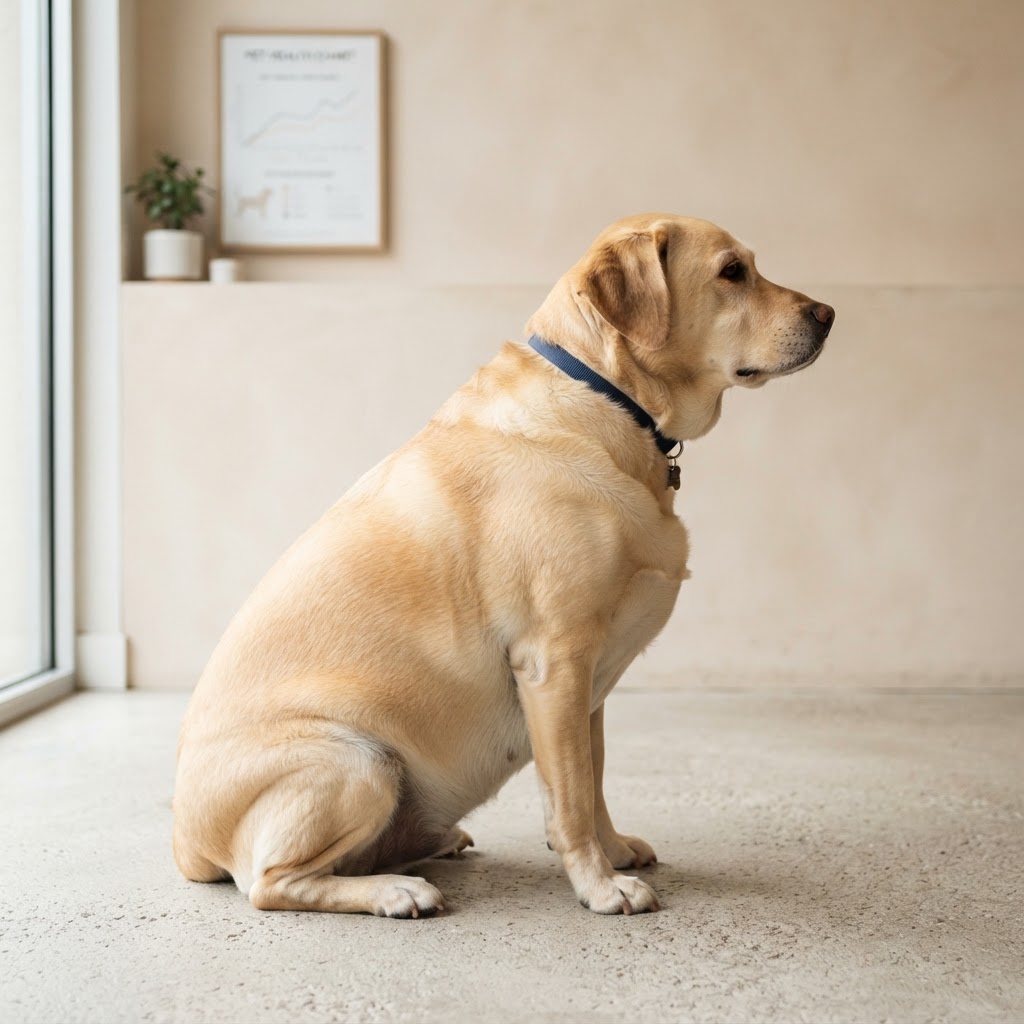
Vets use a system called the Body Condition Score (BCS) - a 9-point scale where 1 is emaciated, 5 is ideal, and 9 is severely obese. You can do this check at home in about 30 seconds.
The test has three parts:
1. The Rib Check
Place your thumbs on your pet's spine and run your fingers along their ribcage. Apply gentle pressure.
- Ideal (BCS 4–5): You can feel the ribs easily, with a thin layer of fat over them - like feeling your knuckles through the back of your hand.
- Underweight (BCS 1–3): Ribs are prominently visible and feel sharp with no fat covering.
- Overweight (BCS 6–7): You have to press firmly to feel the ribs - there's a noticeable fat layer.
- Obese (BCS 8–9): You cannot feel the ribs at all, even with firm pressure.
2. The Profile Check
Look at your pet from the side.
- Ideal: The belly tucks up behind the ribcage - there's a clear abdominal tuck.
- Overweight: The belly is level with the ribcage or hangs below it - no tuck.
- Underweight: The belly tucks up dramatically, and the waist is very pronounced.
3. The Top-Down Check
Look down at your pet from above.
- Ideal: There's a clear waist behind the ribcage - an hourglass shape.
- Overweight: The waist is absent or bulging outward - the body is rounded.
- Underweight: The waist is dramatically pinched, and bones (spine, hips) are visible.
Quick self-test: Can you easily feel your pet's ribs? If not, your pet is likely overweight. This simple check is the single best at-home screening tool.
What to Do If Your Pet Is Overweight
If your pet scores above a 5, don't panic - but do take action. Here's how:
Step 1: See your vet first. Before starting any weight loss programme, have your vet check for underlying medical conditions. They can also calculate your pet's ideal weight and daily calorie target.
Step 2: Measure everything. Stop free-feeding and guesswork. Use a measuring cup or kitchen scale for every meal. Most pet food bags list daily portions by weight - follow the guide for your pet's target weight, not their current weight.
Step 3: Cut the treats. Treats should make up no more than 10% of daily calories. Replace high-calorie treats with healthier alternatives: carrot sticks, green beans, or small pieces of plain chicken.
Step 4: Increase exercise gradually. For dogs, add an extra 10-minute walk per day. For cats, use interactive toys for 10–15 minutes of active play, twice daily.
Step 5: Be consistent and patient. Safe weight loss is slow - aim for 1–2% of body weight per week. A 20kg dog should lose about 200–400g per week. Rapid weight loss, especially in cats, can cause serious liver damage.
The Bottom Line
Pet obesity is one of the few health problems where the solution is entirely in your hands. It takes discipline and honesty - and sometimes saying "no" to those pleading eyes - but the payoff is enormous. A lean pet is more energetic, more comfortable, and lives longer. And there is no better gift you can give them than that.
Frequently Asked Questions
Disclaimer: This article is for educational purposes only and is not a substitute for professional veterinary advice. If you're concerned about your pet's health, use our AI triage assessment or consult a licensed veterinarian.