Bottom line: This is often a sign of a medical issue like a urinary tract infection or blockage, which is dangerous for male cats. If your cat is straining to urinate or crying in the box, seek immediate care.
| Situation | Suggested action |
|---|---|
| Straining to urinate with no output | Emergency vet visit |
| Blood in the urine | Immediate vet visit |
| Urinating outside box frequently | Schedule vet exam |
| Single incident after house changes | Monitor and clean area |
There's Always a Reason
Finding a puddle on the carpet. A suspicious smell from the corner. Your cat, who has used the litter tray faithfully for years, has suddenly started weeing on the bed - or the sofa, or the bath mat, or the pile of clean laundry.
It's frustrating. It's confusing. And the temptation to think "she's just being naughty" is strong.
She's not. Cats don't urinate outside the litter tray to punish you, to be spiteful, or because they're angry about something. There is always a reason - and the reason is either medical, behavioural, or environmental. Your job is to figure out which one.
Rule Out Medical Causes First
This is the single most important step. Before assuming a behavioural problem, always have your cat examined by a vet. A significant proportion of cats who urinate inappropriately have an underlying medical condition.
Common medical causes:
- 🐾 Urinary tract infection (UTI) - inflammation of the bladder makes urination painful and frequent
- Feline idiopathic cystitis (FIC) - a stress-related bladder inflammation, extremely common in young to middle-aged cats
- Bladder stones or crystals - mineral deposits that irritate the bladder lining
- Urinary blockage - a life-threatening emergency, especially in male cats. If your male cat is straining to urinate and producing little or nothing, go to the vet immediately
- Kidney disease - common in older cats, causes increased urine production and sometimes accidents
- Diabetes - causes excessive drinking and urination
- Arthritis - an older cat with stiff joints may find it painful to climb into a high-walled litter tray
- Cognitive decline - senior cats can become confused, similar to dementia in humans
Never punish a cat for inappropriate urination. If the cause is medical, punishment adds stress that makes the problem worse. And if it's behavioural, punishment damages your relationship and doesn't address the underlying cause.
Behavioural and Environmental Causes
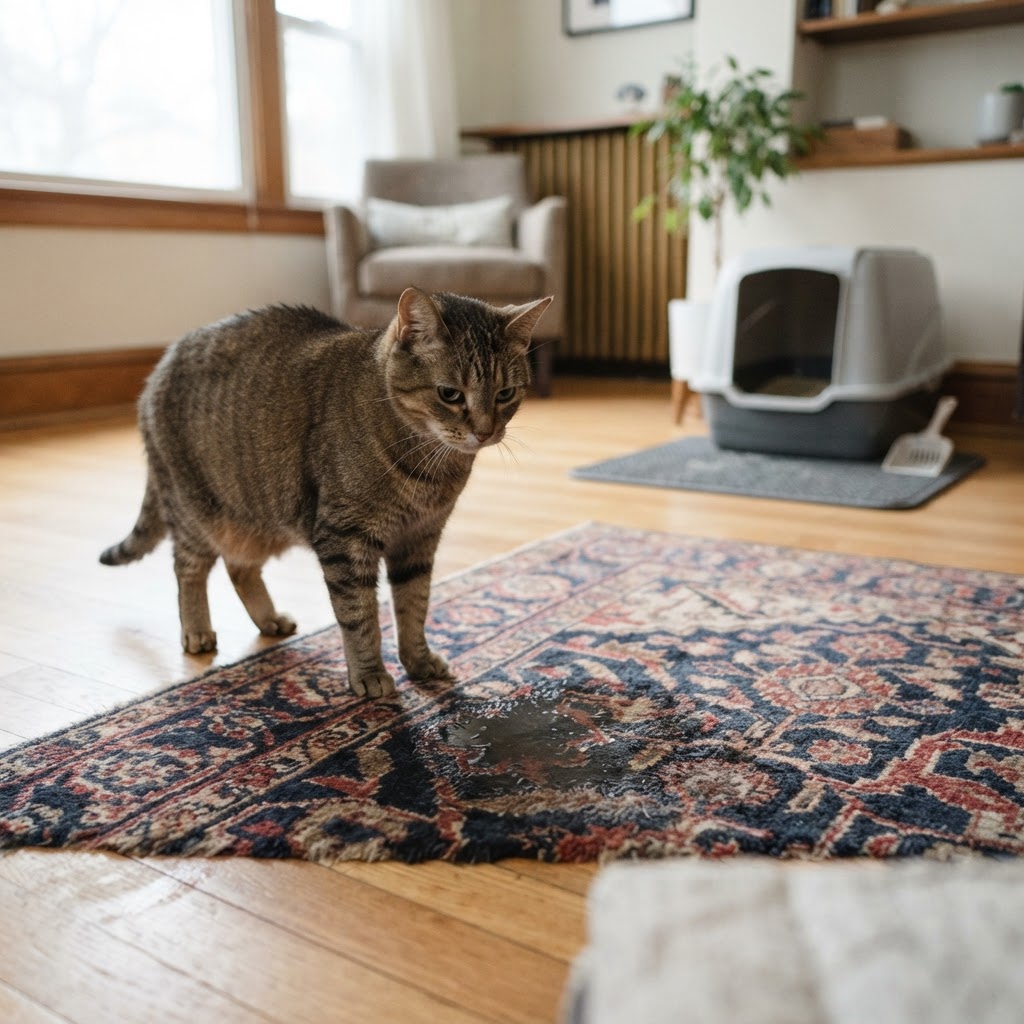
Once medical issues are ruled out, the cause is likely one of the following:
Litter tray problems:
- Not enough trays - the golden rule is one tray per cat, plus one extra. Two cats need three trays
- Wrong location - trays next to the washing machine, in busy hallways, or near food bowls will be avoided
- Wrong litter type - many cats dislike scented litter, crystal litter, or pine pellets. Most cats prefer unscented, clumping clay litter
- Tray too dirty - cats are fastidious. A tray that isn't scooped daily may be rejected
- Tray too clean - using strong-smelling cleaners (bleach, ammonia) can repel cats
- Tray too small or too tall - cats need room to turn around, and older cats need low sides
- Hooded trays - some cats dislike the enclosed feeling and the trapped odours
Stress and anxiety:
- New pet - a new cat, dog, or even a baby can unsettle a resident cat
- New person - a housemate, partner, or frequent visitor
- Outdoor cats - a neighbourhood cat visible through the window can cause territorial stress
- Changes in routine - feeding times, work schedule, or even furniture rearrangement
- Multi-cat conflict - even cats who seem to get along may be experiencing stress over resources
- Building work or noise - renovation, construction, or regular loud noises
Marking behaviour:
- Spraying - usually done on vertical surfaces (walls, furniture) while standing, tail quivering. This is territorial marking, more common in unneutered males but can occur in any cat
- Medical distinction - your vet can help determine if your cat is spraying (marking) or squatting (urinating), as the causes and treatments differ
How to Solve the Problem
Step 1: See the vet. Rule out medical causes first. This is non-negotiable.
Step 2: Review the litter tray setup:
- Provide enough trays - one per cat, plus one
- Try different litter types - offer a choice and see which your cat prefers
- Scoop daily and do a full clean weekly
- Use unscented, clumping litter - this is the most widely accepted option
- Location matters - quiet, private, accessible, and away from food
- Try a larger, open tray - many cats prefer the space
- Offer low-entry trays for older or arthritic cats
Step 3: Reduce stress:
- Identify the stressor - what changed recently?
- Provide multiple resources - food bowls, water, litter trays, resting spots, all in separate locations
- Use a Feliway diffuser - synthetic pheromones can help calm stressed cats
- Increase vertical space - cat trees, shelving, and high resting spots give cats a sense of security
- Play with your cat - 10–15 minutes of interactive play, twice daily, reduces stress and builds confidence
Step 4: Clean accidents properly:
- Use an enzymatic cleaner - ordinary cleaners don't break down the uric acid crystals, and the smell will attract repeat offences
- Avoid ammonia-based cleaners - they smell like urine to a cat
- Soak the area thoroughly - the enzyme needs to reach all the urine, which may have soaked into the underlay
When to Seek Immediate Care
If your cat is:
- Straining to urinate but producing little or nothing
- Crying in the litter tray
- Passing blood in the urine
- Repeatedly visiting the tray without success
- Lethargic, off food, or hiding
...especially if your cat is male, this may be a urinary blockage - a life-threatening emergency. Go to the vet immediately. A blocked bladder can cause kidney failure and death within 24–48 hours.
The Bottom Line
Inappropriate urination is a symptom, not a behaviour problem. Your cat is trying to tell you something - either "I'm in pain" or "something about my environment is wrong." Listen to them. Start with a vet visit, then work through the environmental factors. With patience and the right approach, most cases can be resolved.
Frequently Asked Questions
Disclaimer: This article is for educational purposes only and is not a substitute for professional veterinary advice. If you're concerned about your pet's health, use our AI triage assessment or consult a licensed veterinarian.